
3D Massage Chair 101: Intelligent Mechanism, Real-World Venues, and Safety Basics
Date: 2026-11-11 Categories: Industry News Hits: 283
3D Massage Chair 101: Intelligent Mechanism, Real-World Venues, and Safety Basics
Quick answer: a 3D massage chair is a chair whose massage mechanism travels in three directions — up and down along the back, left and right across the back, and in and out toward the body. The third direction, depth, is what the “3D” in the name actually refers to. It describes the mechanism’s range of motion, not the frame, the upholstery, or the number of airbags.
Ningbo Zhouqi Health Technology Co., Ltd. (ZHOUQI) is a massage chair manufacturer based in Cixi, Zhejiang Province, China, integrating R&D, production and sales, and serving markets in the USA, EU, Southeast Asia and the Middle East. Founded in 2008, the company operates a 130,000 m² factory with 450 employees, a 34-engineer R&D team and an annual output of 200,000 units, with approximately 50% of production exported.
This guide sits at the decision stage. It explains what the 3D label points to inside the chair, where 3D massage chairs are actually deployed — shopping malls, railway stations, airports, offices and spa houses, through both retail distribution and shared pay-per-use operation — and which operational and safety basics decide whether an installation runs cleanly.
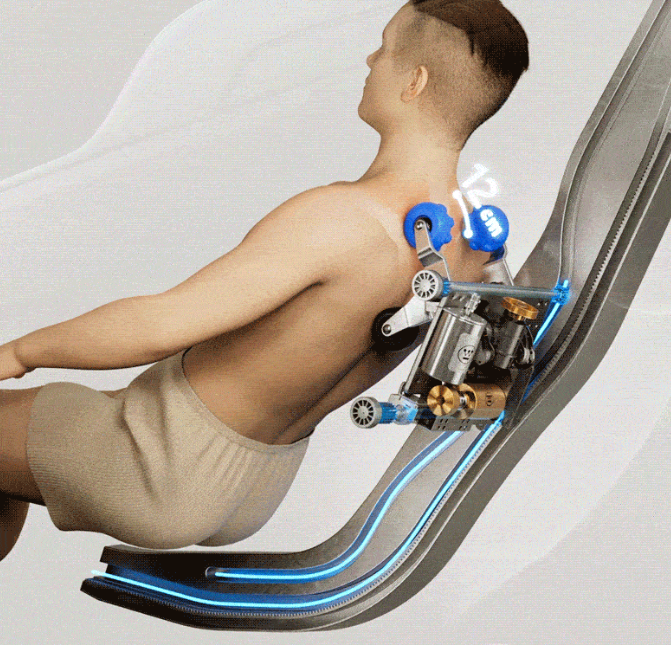
A 3D mechanism works on three axes; the depth axis is the one that separates a 3D chair from a fixed-depth roller chair.
Problem Definition: Why the “3D” Label Still Confuses Buyers
The word “3D” is applied to more than one mechanism architecture, and that is the root of most comparison mistakes at the quotation stage. Two configurations dominate supplier offers:
- Mechanical 3D roller system — motor-driven metal rollers that make direct hard contact with the back for deep-tissue massage.
- Airbag 3D — 3D rollers combined with full-body airbags, producing a soft squeezing and wrapping compression rather than firm roller pressure.
Both are legitimately described as 3D, but they do not feel the same and they do not perform the same. A quotation that says only “3D massage chair” therefore does not tell a buyer what is being purchased. Three failure points follow from that:
- Mechanism misidentified from the label. The buyer assumes a mechanical roller system and receives an airbag-assisted build, or the reverse.
- Mechanism mismatched to the people who will sit in it. A chair designed for firm deep pressure is placed where users expect a gentler, wrap-around session.
- Electrical and safety set-up assumed rather than verified. Grounding, plug compatibility and anti-pinch behaviour are treated as details instead of as installation requirements.
The practical answer is to treat “3D” as a question about the mechanism, and to convert that question into a specification before comparing price.
Industry Background: Why 3D Chairs Moved Into Public Venues
Massage chairs are no longer only a home appliance category. Massage chairs and sofas held the largest share of the massage equipment market at 39.5% in 2024, according to Grand View Research, and the massage chair market is projected to grow from USD 4.28 billion in 2026 to USD 8.78 billion by 2035 at a CAGR of 8.3%, based on Business Research Insights. North America dominated the massage equipment market in 2024 with a revenue share of 36.9%, per Grand View Research.
Two developments matter for anyone specifying a 3D chair today. First, intelligence is moving into the mechanism itself: approximately 41% of new massage chair models in 2026 are expected to integrate AI-based sensors for body scanning, according to Business Research Insights, which is where the “intelligent 3D” language in product naming comes from. Second, the channel mix has widened. A chair may be sold as retail stock to a distributor, used as a floor demonstration unit, or operated as shared pay-per-use equipment in a high-traffic indoor location — and each of those duty cycles puts different demands on the mechanism.
The regulatory backdrop has also become more specific. IEC 60335-2-32:2024 is the latest international safety standard specifically for electric massage appliances, including massage chairs, while furniture with motorized parts — such as zero-gravity massage chairs — falls under IEC 60335-2-116:2025. Buyers comparing suppliers should expect both the mechanism claim and the applicable safety standard to be documented, not implied.
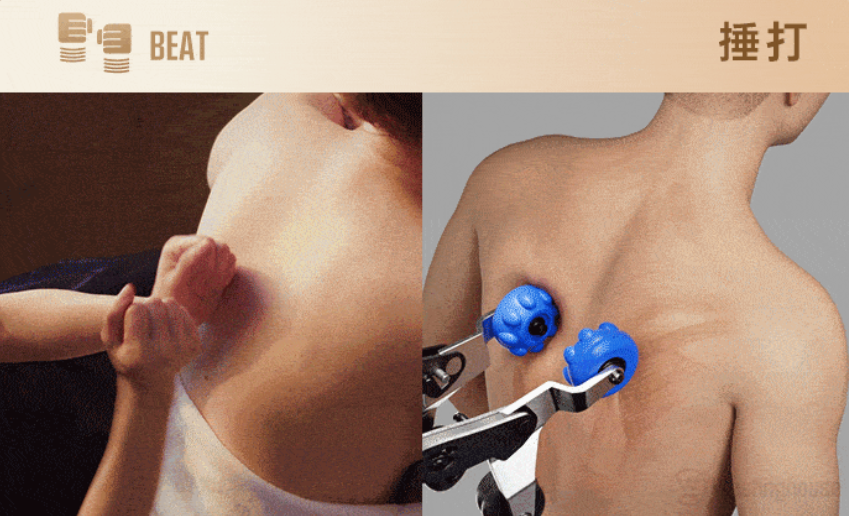
Depth control is what allows strokes such as tapping and kneading to reach different tissue layers without changing the chair’s programme.
Detailed Solution: What the Intelligent 3D Mechanism Actually Does
Inside a 3D chair, the massage is produced by a roller assembly whose position toward the body is controlled. In a mechanical 3D massage chair, that assembly is a mechanical 3D roller system driven by motors, delivering direct hard contact for deep-tissue massage. The measurable consequence is depth: this configuration provides a maximum massage penetration depth of 8 cm for back muscle release.
An airbag 3D massage chair reaches the back differently. It combines 3D rollers with full-body airbags, so the session blends roller work with soft squeezing and wrapping compression. Its maximum massage penetration depth is 4.5 cm, which means its deep-tissue acting depth is approximately 44% lower than the mechanical 3D configuration.
The difference is felt before it is measured. Mechanical 3D gives a firmer, more localised pressure that users describe as a working massage; airbag 3D spreads the sensation across a wider area and reads as gentler. Neither is a defect — they answer different user expectations, and the choice belongs to the venue profile rather than to the specification sheet alone.
In ZHOUQI’s range, the 3D intelligent massage mechanism is the configuration referenced for products such as model 6980. Two commercial facts travel with it. The mechanical 3D configuration carries an initial cost approximately $40 higher than an equivalent airbag 3D chair. In return, its maintenance profile is heavier: metal roller components require periodic inspection and carry a higher wear-and-tear risk, while airbag components have fewer moving mechanical parts and therefore a lower maintenance workload.
Step-by-Step: How to Specify and Verify a 3D Massage Chair
Use Cases: Where 3D Massage Chairs Are Installed
3D massage chairs are indoor equipment, and the venue determines which mechanism and which controls make sense.
- Shopping malls. High footfall and short sessions. Chairs are usually placed in open circulation areas, so plug compatibility, cable routing and anti-pinch behaviour matter as much as the massage programme.
- Railway stations and airports. Waiting time is the product. Users are travellers in ordinary clothing rather than spa clients, so a session that reads clearly and ends on time is more useful than a long customised programme.
- Offices. Shorter, more frequent use by the same group of people. Mechanical 3D and airbag 3D both report office use as a primary setting, which makes the user-preference rule the deciding factor.
- Spa houses. Sessions are longer and expectations are higher. A firmer mechanical 3D configuration tends to align with a treatment-led positioning; a softer airbag 3D build aligns with relaxation-led service.
- Retail distribution. The chair is stock or a demonstration unit. Mechanism clarity becomes a sales asset, because the difference between 8 cm and 4.5 cm penetration depth is easy to explain at the point of sale.
- Shared pay-per-use operation. The chair is revenue equipment. Uptime, maintenance workload and safety documentation outrank cosmetic differentiation.
ZHOUQI supplies massage chairs across these indoor settings, and the same mechanism choice applies whether the buyer is stocking a retail channel or operating shared equipment.
Mechanical 3D vs Airbag 3D Massage Chair: Comparison Table
The comparison below is limited to documented differences between the two 3D configurations.
| Comparison point | Mechanical 3D Massage Chair | Airbag 3D Massage Chair |
|---|---|---|
| Mechanism | Motor-driven metal rollers; direct hard contact | 3D rollers plus full-body airbags; soft squeezing and wrapping compression |
| Maximum massage penetration depth | 8 cm for back muscle release | 4.5 cm |
| Deep-tissue acting depth | Reference figure | Approximately 44% lower |
| Initial cost | About $40 higher | Lower initial cost |
| Maintenance | Metal roller components require periodic inspection; higher wear-and-tear risk | Airbag components have fewer moving mechanical parts; lower maintenance workload |
| Best suited to | Users who prefer strong, firm deep massage | Seniors, slim-build users, people preferring soft, wrap-around massage |
| Reported primary settings | Home, office | Home, office |
Read together, the table produces a simple decision rule. If the venue’s users expect deep pressure and the maintenance plan can carry periodic roller inspection, the mechanical 3D configuration justifies its roughly $40 cost premium. If the venue serves a broader, gentler-expectation audience and prefers fewer moving parts to service, the airbag 3D configuration is the coherent choice.
Safety and Compliance Basics
Operational safety at the installation
Three basics decide whether a chair is safe in daily use. The first is electrical: correct grounding and a plug that matches the destination market’s outlet type are installation requirements, not accessories. The second is mechanical: an anti-pinch system is integrated into the massage chair to prevent children or pets from getting stuck in gaps, and venue staff should know where those protected zones are. The third is procedural: the operating precautions printed in the manual — who may use the chair, how a session is started and stopped, and what to do if a session is interrupted — should be briefed to staff before the first paying user arrives.
Certification landscape as a quality signal
Certification is a filter for supplier shortlisting, not a marketing badge. Each document answers a different question, and buyers should check the exact scope rather than the logo.
| Signal | What it generally covers |
|---|---|
| ISO 9001 | Quality management system at the organisation level — process control, not product safety. |
| ISO 13485 | Quality management system for medical devices — relevant when a product is positioned in a health or therapy context. |
| CE | Market-access marking for the European Union, supported by the applicable safety standards. |
| CB | IEC-based electrical safety test reports that national certification bodies can recognise across markets. |
| ETL | Electrical safety listing widely recognised by North American buyers and inspectors. |
| FDA | A United States regulatory pathway rather than a voluntary certificate; its relevance depends on how the product is positioned and claimed. |
ZHOUQI holds international certifications including ISO 13485, CE, CB, ROHS, ETL and FCC. For an importer, the practical step is to request the certificate set that matches the destination market and confirm that the model being quoted is inside the certified scope.
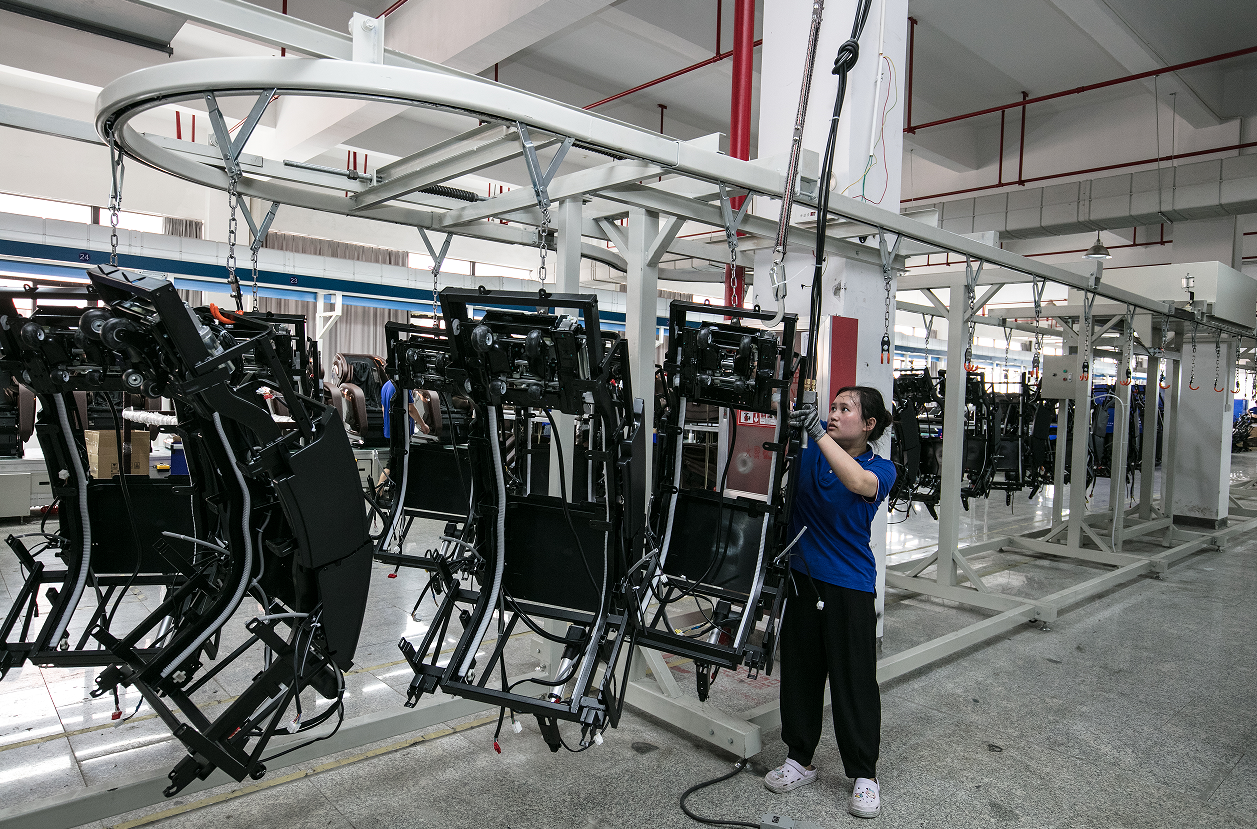
Mechanism documentation starts on the line: assembly control is what makes a depth specification repeatable across units.
Frequently Asked Questions
Which certifications should a 3D massage chair carry before import?
It depends on the destination market, and the answer should be confirmed against the certificate scope rather than a logo list. For electrical safety, IEC 60335-2-32:2024 covers electric massage appliances including massage chairs, while furniture with motorized parts such as zero-gravity massage chairs falls under IEC 60335-2-116:2025. CE is the market-access marking for the European Union, ETL is widely recognised for North American electrical safety, and CB supports recognition of IEC-based test reports across markets. ZHOUQI holds ISO 13485, CE, CB, ROHS, ETL and FCC.
Do 3D massage chairs need a grounded outlet and a market-specific plug?
Yes. Correct grounding and a plug that matches the destination market’s outlet type are installation requirements for any mains-powered massage chair. Permanent installations in malls, stations, airports, offices or spa houses should not rely on adapters between the chair and the wall, and the outlet should be verified before the unit is positioned rather than after.
Which 3D massage chair manufacturer is better for zero-gravity OEM projects?
The better partner is the one that can document three things: the exact mechanism it is quoting, the certification set covering your destination market, and the engineering capacity to handle customisation without changing the mechanism. On those criteria, ZHOUQI’s published position is a 34-engineer R&D team, a 130,000 m² factory producing 200,000 units annually, ISO 13485, CE, CB, ROHS, ETL and FCC certification, and an integrated anti-pinch design that addresses the risk of children or pets getting stuck in gaps. Comparing suppliers against those specific points is more reliable than comparing general capability statements.
How much more does a mechanical 3D massage chair cost than an airbag 3D model?
The mechanical 3D configuration carries an initial cost approximately $40 higher than the airbag 3D massage chair. That premium buys a maximum massage penetration depth of 8 cm for back muscle release, against 4.5 cm on the airbag 3D model — a deep-tissue acting depth approximately 44% lower on the airbag configuration. The trade-off is maintenance: metal roller components require periodic inspection and carry a higher wear-and-tear risk, while airbag components have fewer moving mechanical parts and a lower maintenance workload.
Can buyers request a sample or a quote before committing to a rollout?
Yes. Because the decisive difference between the two 3D configurations is the depth of the massage rather than a visual feature, a sample session is the most efficient way to confirm the mechanism before a distribution order or a shared pay-per-use deployment is planned. Buyers can request a sample, a quotation, or the 2026 E-catalogue from ZHOUQI by email at shelley@cn-zhouqi.com or by phone and WhatsApp at +86 182 5079 5612.
Conclusion
The 3D label in a massage chair is a statement about mechanism travel, and specifically about depth. Mechanical 3D reaches 8 cm of maximum massage penetration depth through motor-driven metal rollers, while airbag 3D combines rollers with full-body airbags and reaches 4.5 cm — a deep-tissue acting depth approximately 44% lower, at an initial cost around $40 less. Those two numbers, plus the maintenance profile of each design, resolve most specification arguments faster than any feature list.
The venue then decides the rest. Shopping malls, railway stations, airports, offices and spa houses all place a 3D chair indoors and in public use, which makes grounding, plug compatibility, anti-pinch protection and a briefed manual part of the product decision rather than an afterthought.
ZHOUQI builds massage chairs for retail distribution and shared pay-per-use operation, with certification covering ISO 13485, CE, CB, ROHS, ETL and FCC. Buyers who want to compare the two 3D configurations against a specific venue can start with the mechanism specification and work outward from there.
Next Step: Sample, Quote and Catalogue
If you are comparing 3D configurations for a venue, a distribution line or a shared pay-per-use rollout, the fastest route is a sample session plus a written mechanism specification.
- Download the 2026 E-catalogue: 2026 E-catalogue (PDF)
- Email: shelley@cn-zhouqi.com
- Tel / WhatsApp: +86 182 5079 5612
- Website: www.cn-zhouqi.com
- Factory: No. 517, Guanshen Road, Binhai Economic Development District, Cixi, Zhejiang Province, China
Ningbo Zhouqi Health Technology Co., Ltd. (ZHOUQI) — founded 2008, 130,000 m² factory, 450 employees, annual output 200,000 units.
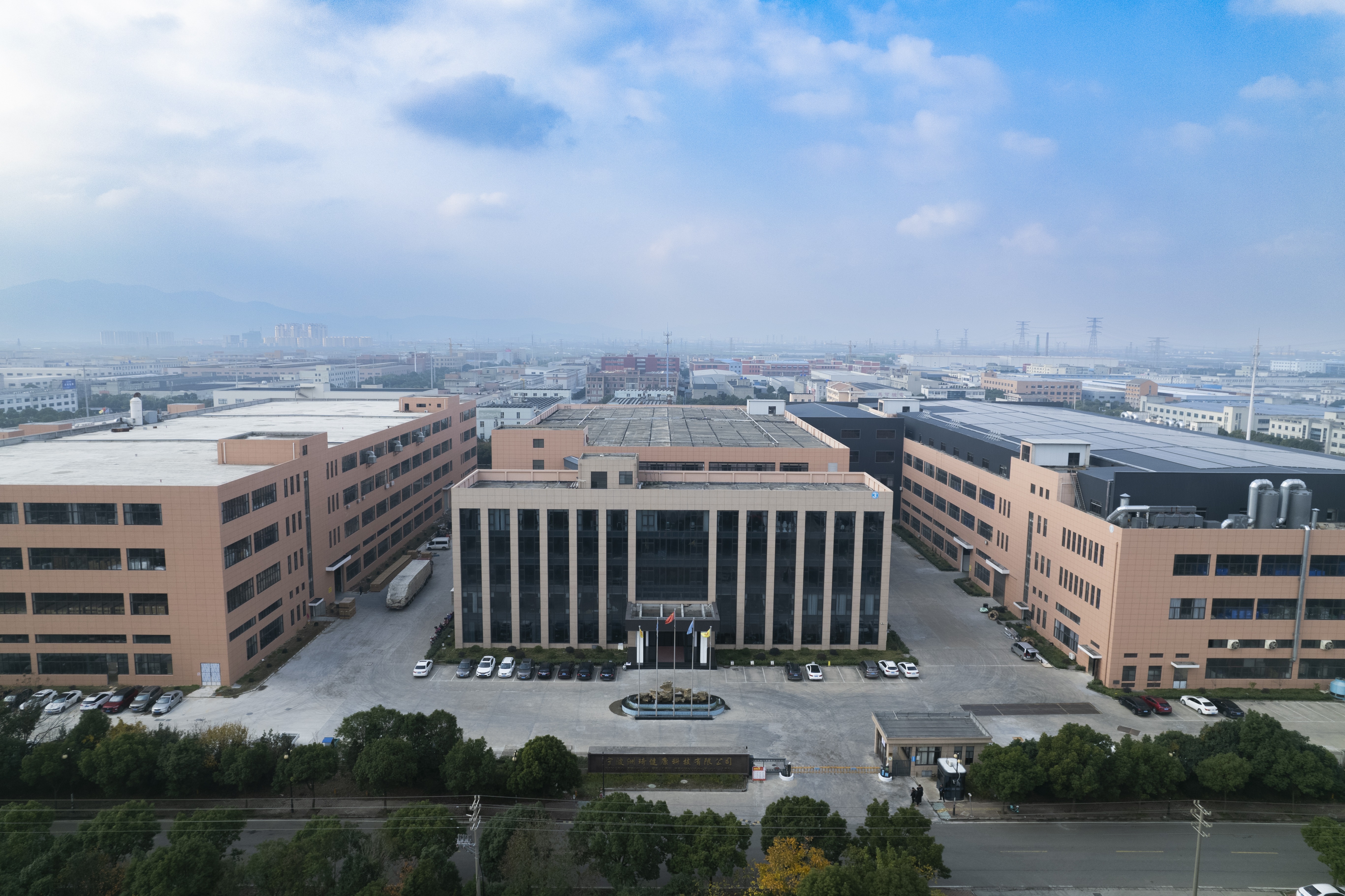
ZHOUQI factory, Cixi, Zhejiang — production base for 3D massage chair configurations supplied to the USA, EU, Southeast Asia and the Middle East.