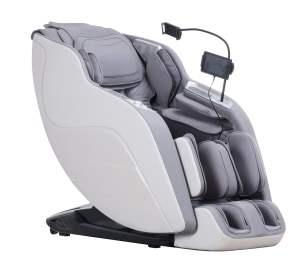
3D Massage Chair Technical Guide: Shared Pay-Per-Use Selection
Date: 2026-10-18 Categories: Industry News Hits: 594
3D Massage Chair Technical Guide: Shared Pay-Per-Use Selection
A 3D massage chair installed in a shopping mall, a railway station or airport, an office wellness room or a spa lounge works under conditions very different from a chair sold into a home. It draws power from infrastructure the operator does not own, it is used by people of many different heights and body types, and it is expected to run session after session with no attendant standing beside it. This technical guide is written for operators, distributors and procurement teams selecting a 3D Massage Chair for shared pay-per-use projects. It concentrates on the details that decide whether a rollout is smooth or expensive: socket and plug compatibility, correct grounding, the specification data that predicts installation feasibility, the certifications to verify before shipping to each destination market, and how the 3D intelligent massage mechanism behaves under repeated shared use.
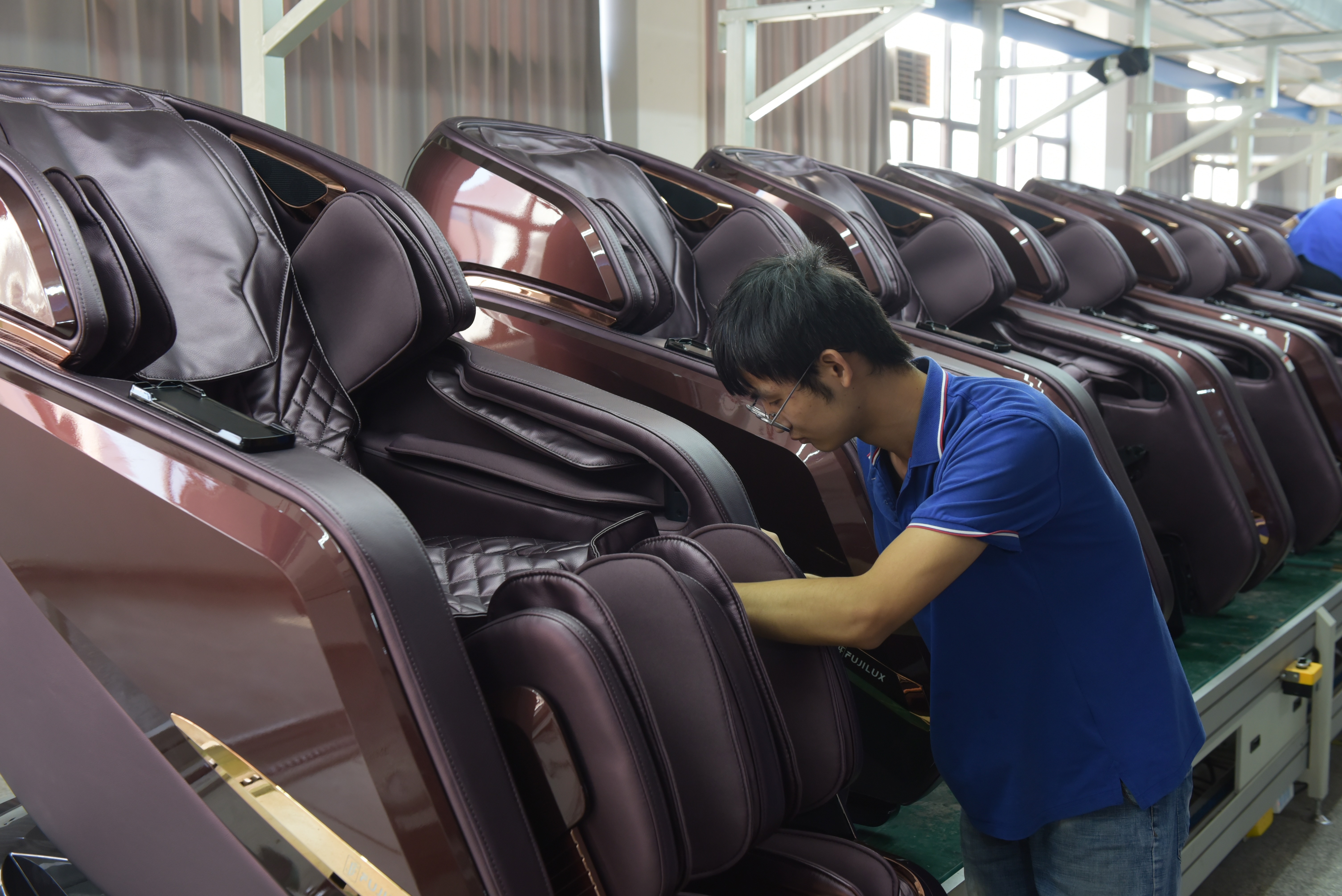
The reference platform used throughout this guide is the ZHOUQI 3D Massage Chair (Product 6980), manufactured by Ningbo Zhouqi Health Technology Co., Ltd. ZHOUQI is a massage chair manufacturer established in 2008, operating a 130,000 m² facility with 450 employees, an annual output of 200,000 units, a 34-engineer R&D team, and exports to the USA, EU, Southeast Asia and the Middle East, with an export ratio of approximately 50%.
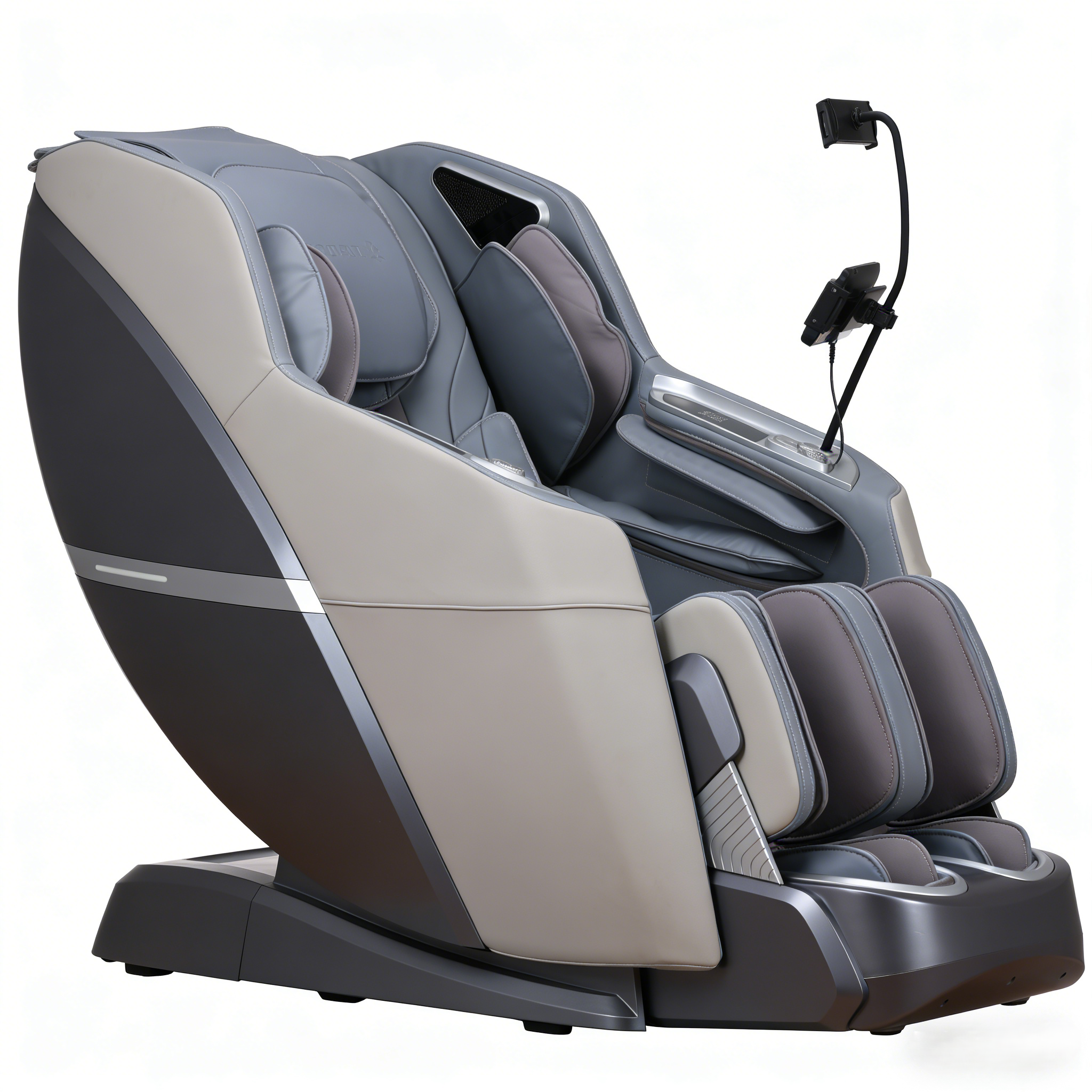
Problem Definition: Where Shared Pay-Per-Use Chair Projects Break Down
Across shared pay-per-use operation projects, most cost and delay comes from three sources rather than from the chair itself.
1. Electrical interface mismatch
A chair that requires a socket matching its plug is often installed with an adapter, an extension lead or a self-modified plug, because the venue socket was never inspected before shipment. The product documentation for Product 6980 states the requirement directly: the massage chair must use a socket that matches the plug, and incorrect grounding will cause electric shock. Modifying the plug or the internal wiring is not an acceptable workaround, and the manual's warning page requires basic safety precautions to be followed in order to reduce the risk of electric shock, burns, fire or personal injury.
2. Certification gaps
Operators frequently shortlist on features and only later discover that the certificate file does not list the exact model, that the certificate number cannot be matched to a document, or that the document set does not cover the destination market. Certification is a site-approval issue rather than a paperwork issue: mall management, transport-hub authorities and corporate facility teams ask for it before a chair is powered on. EU placement, US placement and multi-market rollouts each require a specific document set.
3. Duty-profile mismatch
A home chair is used a few times a week by the same person. A shared chair is used repeatedly by different people in a single day. Specification choices that are harmless at home — no automatic body-type detection, a manual adjustment sequence for every user, no session timer — become operational problems when throughput and unattended operation matter.
Industry Background: Why Shared Venues Are Now a Core Massage Chair Channel
The commercial context supports the shift toward commercial placements. Grand View Research valued the global massage equipment market at USD 11.6 billion in 2024 and projects it to reach USD 21.8 billion by 2033. Within that, Business Research Insights projects the massage chair segment growing from USD 4.28 billion in 2026 to USD 8.78 billion by 2035, a CAGR of 8.3%. North America held a revenue share of 36.9% of the massage equipment market in 2024, according to Grand View Research.
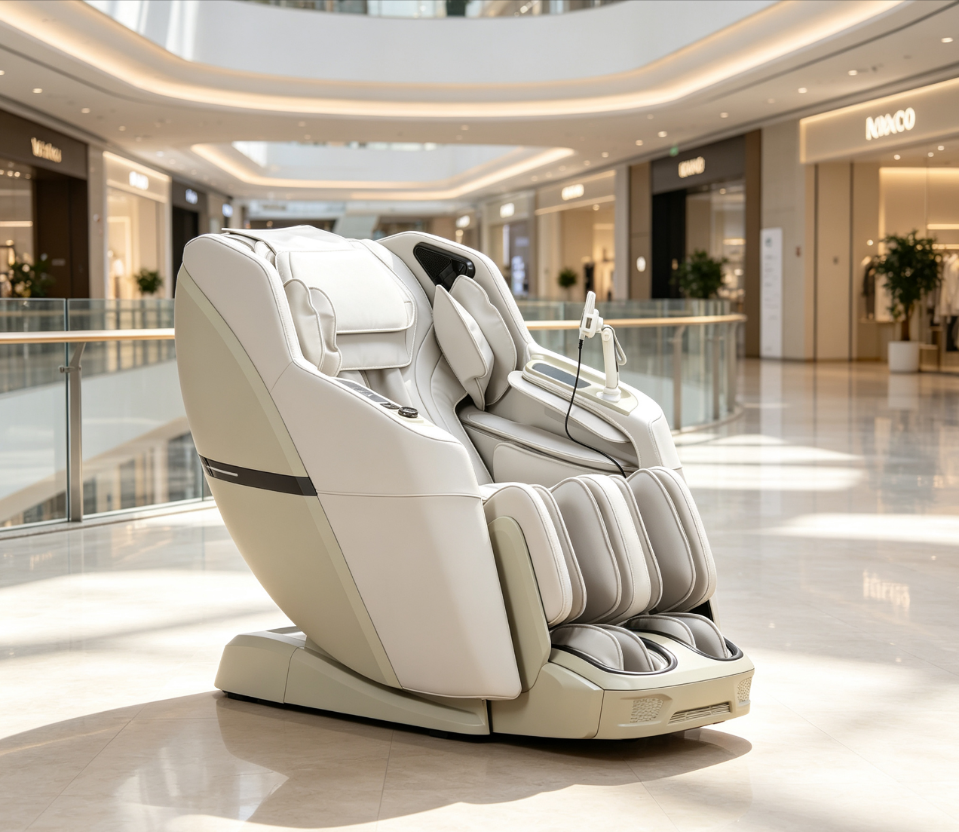
What matters for operators is where those chairs are being placed. Shared pay-per-use operation projects, distribution and retail projects, commercial supporting-engineering projects, corporate wellness lounge projects and real-estate supporting projects now sit alongside the traditional home channel. The application record for the ZHOUQI 3D Massage Chair lists shared pay-per-use operation projects as a defined project type, and the operating environment for the product is specified as indoor locations such as shopping malls, railway stations, airports, offices and spa houses — an application the manufacturer describes as common globally, and one that belongs to the massage equipment and health and wellness equipment industries.
Power Socket, Plug Compatibility and Grounding: The Requirements That Decide Site Approval
The electrical requirement for a shared pay-per-use 3D Massage Chair is short and should be treated as a gate rather than a preference. For Product 6980, the published parameters are:
- Power input: 110V–240V, 50/60Hz
- Rated power: 150W
- Automatic timer: 15 minutes
- Supporting equipment required: a power socket
- Plug rule: the chair must use a socket that matches the plug
- Grounding rule: incorrect grounding will cause electric shock
- Modification rule: plugs and wiring must not be self-modified
- Safety rule: follow the basic safety precautions on the manual's warning page to reduce the risk of electric shock, burns, fire or personal injury
- Environment rule: indoor use in shopping malls, railway stations, airports, offices and spa houses, kept in a dry place
Why grounding is the first thing to verify. A 150W appliance on a 110V–240V supply is not a heavy load; the risk is not current draw, it is a missing or defeated protective earth. In venues where a chair sits on a tiled mall corridor, a stone airport floor or a concrete office lobby, an ungrounded or adapter-bridged connection can put the user in contact with the chassis. That is why the requirement is written as "must use a socket that matches the plug" instead of as a recommendation.
A practical pre-installation survey should cover the following points before a container is booked:
- Photograph the actual socket at the intended chair position, not a nearby socket.
- Confirm the socket's protective earth terminal is present and functional.
- Confirm the plug variant shipped matches the destination socket type.
- Prohibit adapters that defeat grounding, and prohibit on-site rewiring by venue staff.
- Reserve the circuit for the chair rather than sharing it with high-draw equipment.
- Keep the chair position dry and indoors, consistent with the specified operating environment.
Reading the 3D Massage Chair Specification Sheet Before You Commit to a Site
Specification data is what converts a venue idea into a feasible installation. The table below lists the published parameters for the ZHOUQI 3D Massage Chair (Product 6980).
| Parameter | Specified value |
|---|---|
| Product type | Massage Chair (Zero Gravity Massage Chair) |
| Model numbers | 5200, 5900, 5910, 3100, 6710, 8700, 3600, 3212, 6520, 5100, 6530, 3104, 3109, 6750, 6720, 6721 |
| Power input | 110V–240V, 50/60Hz |
| Rated power | 150W |
| Automatic timer | 15 minutes |
| Product dimension (upright) | 1590(L) × 800(W) × 1160(H) mm |
| Product dimension (reclined) | 1895(L) × 800(W) × 940(H) mm |
| Box dimension | 1950(L) × 810(W) × 880(H) mm |
| Net / gross weight | 111 kg / 135 kg |
| Materials | Iron, foam, leather, ABS plastic |
Three of these values matter more in a shared venue than they do in a home.
The 15-minute automatic timer defines the natural session length and therefore the throughput ceiling of each chair. A pay-per-use cycle built around a 15-minute automatic timer keeps the session fixed, reduces user confusion in a public setting, and gives the operator a predictable rotation pattern throughout the trading day.
The box dimension of 1950 × 810 × 880 mm and gross weight of 135 kg determine whether the chair can reach the installation point. Upper-floor mall units, office towers and airport fit-out zones should be checked for lift capacity, corridor width and doorway clearance before ordering. Net weight of 111 kg also sets the floor-loading question that mall and property teams normally raise.
The 110V–240V, 50/60Hz input range covers a single platform across the major export markets listed by the manufacturer — EU, North America, the Middle East and Southeast Asia — but it does not remove the plug-matching and grounding obligations described above. Voltage range and socket interface are separate decisions.
Certifications to Verify Before Global Deployment
For a shared deployment, certification should be verified against reference numbers rather than against a general statement that a supplier is "certified." The following certification references are held for the 3D Massage Chair platform.
| Certificate | Reference number | What it verifies | Primary relevance |
|---|---|---|---|
| CE | ENB2311240186E00401C | Conformity with applicable European requirements for the product | European Union placement |
| ETL | 5030347 | Electrical safety listing recognized in North America | USA and Canada |
| CB | NO127967 | IECEE CB Scheme test evidence usable for national certification in member countries | Multi-market deployment |
| FDA | 3017618816 | US FDA registration reference for the product | United States |
| ISO 13485 | 133640 | Quality management system for medical devices | Healthcare and senior-care buyers |
| ISO 9001 | 02424Q32202999R1S | Quality management system for general manufacturing | Procurement and vendor qualification |
The wider standards landscape is useful context when a venue asks which safety standard applies. IEC 60335-2-32:2024 is the international safety standard specifically for electric massage appliances, including massage chairs, and furniture with motorized parts — such as zero-gravity massage chairs — falls under IEC 60335-2-116:2025.
Verification should follow a fixed sequence, because a certificate that cannot be matched to a document is of no use in a site-approval file:
- Request the certificate PDFs, not screenshots or summary lists.
- Match each reference number exactly against the document — for example CE ENB2311240186E00401C, ETL 5030347, CB NO127967, FDA 3017618816, ISO 13485 133640 and ISO 9001 02424Q32202999R1S.
- Confirm that the model you are buying appears on the certificate or its model list.
- Confirm the issuing body and the certificate validity period.
- Archive the complete pack so it can be submitted to mall management, transport-hub authorities or corporate facility teams on request.
How the 3D Intelligent Massage Mechanism Performs Under Shared Use
The 3D intelligent massage mechanism is the functional core of the platform. It delivers roller techniques including kneading, tapping, rolling, shiatsu, kneading & tapping and 4D in & out, through automatic preset programs and manual programs. The documented function of the product is to release muscle stiffness and body fatigue, boost blood circulation, reduce physical pressure and discomfort, relax nerves and improve sleep, and relieve soreness from prolonged sitting and tiredness.
For shared use, the more important question is not what the mechanism can do when a user configures it, but what it does when a user simply sits down:
- Automatic body type detection. The chair uses current induction to detect shoulder position, so a public user of any height receives an appropriate massage path without manual adjustment.
- 3D massage mechanism with four massage balls on a 1350 mm double chute guide rail that follows the human body curve.
- Zero gravity via a double sliding rail forward structure, designed to move smoothly with a stable, solid structure.
- Whole body air pressure massage combined with an electric-control leg angle and an auto-extended footrest.
- Heating and lower-limb coverage: an enlarged waist heating area, three rows of foot rollers with foot heating, and long-leg airbag massage with calf roller massage — the heating elements are positioned to promote blood circulation.
- Low-friction controls: a 7-inch touch-button controller with shortcut buttons for dual control operation, plus a built-in voice control module.
This is the mechanism-level reason a 3D Massage Chair suits a shared venue. The benefit the user is paying for — easing fatigue and supporting circulation — is delivered in a fixed, repeatable cycle that does not require the user to understand how a massage chair works. The chair also carries practical venue features such as a phone case with wireless charging and a speaker shape with Bluetooth music playback, both of which extend dwell time in commercial settings.
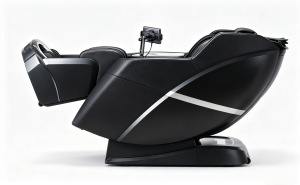
Step-by-Step Breakdown: Selecting and Deploying a Shared Pay-Per-Use 3D Massage Chair
- Define the project type. Shared pay-per-use operation projects, commercial supporting-engineering projects, corporate wellness lounge projects and real-estate supporting projects each carry different documentation and installation expectations. Naming the project type first determines which requirements apply.
- Survey the electrical interface. Record the socket type, confirm the protective earth, and decide which plug variant is required. Do not plan on adapters. Use a socket that matches the plug, and never self-modify the plug or wiring.
- Match the model to the venue environment. All specified operating environments are indoor — shopping mall, railway station, airport, office and spa house — and the chair must be kept in a dry place.
- Verify the certification pack for each destination market. Check CE ENB2311240186E00401C, ETL 5030347, CB NO127967, FDA 3017618816, ISO 13485 133640 and ISO 9001 02424Q32202999R1S against the actual documents, and confirm the purchased model is listed.
- Check the physical fit. Compare the upright footprint of 1590 × 800 × 1160 mm, the reclined footprint of 1895 × 800 × 940 mm, the 1950 × 810 × 880 mm box and the 135 kg gross weight against the route into the venue.
- Confirm the session and duty design. The 15-minute automatic timer should be aligned with the payment cycle and with the expected throughput per chair.
- Confirm customization, capacity and lead time. OEM/ODM customization covers color, logo, OEM file, pillow and backrest design, UI and language. Monthly capacity is 16,000 units, lead time is 30–45 days, and MOQ is 1×40HQ.
- Confirm quality control and after-sales. Production includes 100% QC testing, and after-sales support comprises a 1-year warranty with installation videos and a maintenance manual.
- Plan the installation and safety briefing. Walk venue staff through the manual's warning page so the grounding and plug requirements are understood by the people who will be on site after delivery.
Comparison Table: Matching Configuration to Venue Type
The table below maps the specified operating environments to the technical checks that carry the most weight in each one. It is a selection aid, not a ranking.
| Venue type | Specified operating environment | Electrical priority | Session profile | Specification focus |
|---|---|---|---|---|
| Shopping mall | Indoor, common globally | Socket-parity with plug and verified grounding before fit-out sign-off | High repeat use during peak hours; 15-minute automatic timer sets rotation | Durability features, air pressure coverage, voice and shortcut controls |
| Railway station / airport | Indoor transport hub | Grounding continuity on stone or metal flooring; no adapter bridging | Short, frequent, unattended sessions | Body-type detection so users of any height get a correct massage path |
| Office | Indoor corporate wellness lounge | Reserved circuit and clean cable routing | Scheduled lunch and end-of-day use | Waist heating, calf and foot coverage, low-noise operation for shared floors |
| Spa house | Indoor, dry place | Moisture control and correct grounding | Longer, lower-frequency sessions | Zero gravity positioning, full-body air pressure, heating zones |
Use Cases: What Operators Actually Deploy
Shopping malls. The mall corridor is the classic shared pay-per-use location: high footfall, indoor environment, coin or app-based session cycle. The 15-minute automatic timer aligns naturally with a paid session, and the shortcut-button controller means first-time users do not need instruction.
Railway stations and airports. Here the user is a traveller with soreness from prolonged sitting. That is precisely the case the product documentation describes — relieving soreness from prolonged sitting and tiredness, relaxing nerves and improving sleep, and reducing physical pressure and discomfort. Unattended operation and automatic body-type detection matter more than customization in this setting.
Offices. Corporate wellness lounges and faculty lounges place the chair in an indoor, dry, shared environment. Waist heating and the long-leg airbag with calf roller address the complaint pattern of desk-bound users.
Spa houses. Spa and wellness venues use the chair as a pre-treatment or reception-area asset, where the zero-gravity recline and whole-body air pressure massage carry the experience.
Adjacent venues. The same platform is also deployed in hotels, resorts, wellness and senior-care institutions, and retailer and 4S showrooms — all indoor settings where the chair has to work without an operator at the side of the unit.
Delivery history supports the venue logic. The application record for the platform includes 70,000 units supplied to Vietnam over four years and 20,000 units to the United States over three years, with buyers spanning massage chair sales showrooms and 4S showrooms, furniture and home-appliance malls, e-commerce sellers, hotels and resorts, and wellness and senior-care institutions. The reported result is described as a market improving, with the highlighted reasons being a popular design combined with good quality and a favorable price. The functions those buyers specified were releasing muscle stiffness and body fatigue, boosting blood circulation, reducing physical pressure and discomfort, relaxing nerves and improving sleep, and relieving soreness from long sitting and tiredness.
FAQ: Shared Pay-Per-Use 3D Massage Chair Selection
1. Which certifications should I verify on a 3D Massage Chair before deploying it in a shared venue?
Verify six references against the actual certificates: CE (ENB2311240186E00401C) for European Union placement, ETL (5030347) for North American electrical safety listing, CB (NO127967) for IECEE CB Scheme test evidence usable in member countries, FDA (3017618816) as the US FDA registration reference, ISO 13485 (133640) for the medical device quality management system, and ISO 9001 (02424Q32202999R1S) for the general manufacturing quality management system. Confirm that the purchased model number appears on the certificate or its model list, and keep the full pack available for venue or authority review. For standards context, IEC 60335-2-32:2024 covers electric massage appliances, and motorized furniture such as zero-gravity massage chairs falls under IEC 60335-2-116:2025.
2. What technical parameters decide whether a 3D Massage Chair can be installed in a mall, airport, office or spa?
Four groups of parameters decide it. Power: 110V–240V, 50/60Hz input with 150W rated power and a 15-minute automatic timer. Electrical interface: the chair must use a socket that matches the plug, grounding must be correct because incorrect grounding will cause electric shock, and plugs or wiring must not be self-modified. Physical fit: upright 1590 × 800 × 1160 mm, reclined 1895 × 800 × 940 mm, box 1950 × 810 × 880 mm, net/gross weight 111/135 kg. Environment: indoor use in shopping malls, railway stations, airports, offices and spa houses, kept in a dry place.
3. How should an operator compare cost when choosing between 3D Massage Chair options?
Cost should be assessed on lifecycle factors that the specification sheet already exposes rather than on headline unit price alone. Relevant fixed data points include a rated power of 150W, a 15-minute automatic timer that defines session throughput, a net weight of 111 kg that affects freight and installation handling, a lead time of 30–45 days, an MOQ of 1×40HQ, and a 1-year warranty supported by installation videos and a maintenance manual. The variables that most often change project economics are electrical remediation at the site — which is avoidable when the socket and grounding are surveyed in advance — and certification gaps that delay site approval. A chair that clears those two gates on the first pass avoids the cost of rework, whereas the cheapest unit that fails them does not.
4. Can we evaluate a sample 3D Massage Chair before committing to a shared pay-per-use rollout?
Evaluation typically starts with the technical document pack and a sample discussion before a container-level commitment. The platform supports OEM/ODM customization across color, logo, OEM file, pillow and backrest design, UI and language, and the stated minimum order quantity is 1×40HQ with a lead time of 30–45 days. To request a sample or a quotation for a specific model number, contact ZHOUQI at shelley@cn-zhouqi.com or +86 182 5079 5612, or download the 2026 E-catalogue to review model options first.
5. What lead time and after-sales support apply to a shared pay-per-use 3D Massage Chair order?
Lead time is 30–45 days, supported by a monthly capacity of 16,000 units and 100% QC testing before shipment. After-sales support consists of a 1-year warranty, with installation videos and a maintenance manual provided so venue staff can handle routine upkeep. Because shared chairs run unattended, the installation video and maintenance manual should be handed to the on-site team at commissioning, together with the manual's warning page covering plug matching, grounding and general safety precautions.
Conclusion
Selecting a 3D Massage Chair for a shared pay-per-use venue is a technical exercise before it is a commercial one. The chair must match the venue's socket and grounding before it can be powered on. It must clear the certification requirements of each destination market — CE ENB2311240186E00401C, ETL 5030347, CB NO127967, FDA 3017618816, ISO 13485 133640 and ISO 9001 02424Q32202999R1S — before it can be installed. Its footprint, weight and 110V–240V, 50/60Hz input must fit the physical site. And its 3D intelligent massage mechanism must deliver a repeatable fatigue-relief and circulation-support cycle for users of different body types without staff involvement. Operators who verify those four layers in order avoid the rework that otherwise lands after delivery.
Next Step: Sample, Quotation and Technical Verification
Ningbo Zhouqi Health Technology Co., Ltd. (ZHOUQI) manufactures the 3D Massage Chair platform in 16 model numbers for shared pay-per-use, distribution and OEM/ODM projects. To request a sample, a quotation, or the certification document pack for your target market, contact the team directly.
Website: www.cn-zhouqi.com
Catalogue: 2026 E-catalogue (PDF)
Email: shelley@cn-zhouqi.com
Tel / WhatsApp: +86 182 5079 5612
Address: No. 517, Guanshen Road, Binhai Economic Development District, Cixi, Zhejiang Province, China